Cividale del Friuli - UNESCO World Heritage Site
You can not leave Cividale without having immersed yourself in its history by visiting these places first.

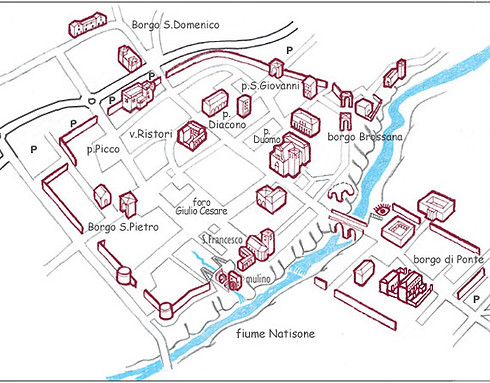
1
2
3
4
5

1 - Celtic Hypogeum
The Celtic hypogeum of Cividale del Friuli consists of a series of underground rooms, carved into the rock. It has a multi-level and multi-branch development. Scholars are still uncertain about the original function of this monument, which finds little comparison. Some are inclined towards a funeral use during the Celtic period, others believe that the environment may have been used in Roman or Lombard times as a prison.
2 - Tempietto Longobardo
The so-called Tempietto Longobardo, today oratory of Santa Maria in Valle, is located in Cividale del Friuli, in the province of Udine. This is the most important and best preserved architectural testimony of the Longobard era and is particularly important because it marks the coexistence of purely Lombard motifs (in the Friezes, for example) and a revival of the classical models, creating a sort of uninterrupted courtly continuity between the Roman art, Longobard art and Carolingian art (in whose worksites they often worked Longobard workers, like in Brescia) and Ottonian. It is part of the serial site "Longobardi in Italy: places of power", including seven places full of architectural, pictorial and sculptural evidence of Longobard art, inscribed on the UNESCO list of World Heritage Sites in June 2011.
.


3 - National Archeologic Museum
Founded in 1817, the Museum has been housed since 1990 in the sixteenth century Palazzo dei Provveditori Veneti. The Museum's collection recounts the history of the city in the rooms on the ground floor, from the Roman town hall to the period of Venetian domination. The stages are marked by beautiful mosaics from the domus, letters carved in public inscriptions and sculptures from churches and palaces of the medieval Cividale. The main floor houses the rich Lombard section, a wonderful sequence of objects from the necropolis of Cividale and its duchy, which tells the charm and the particularity of the culture of the Longobards and hands down the importance of their contribution in the formation of medieval Italy.

4 - Ponte del Diavolo
The Ponte del Diavolo (Puìnt dal Diàul in Friuli) is the symbol of the city of Cividale del Friuli (UD). Built in stone from 1442 and divided into two arches, it rests on a natural boulder placed in the bed of the Natisone river, along which you can admire a spectacular gorge.
The name of the bridge derives from a popular legend: it is said that to build the bridge, the Cividalese had asked the Devil for help. He would have demanded in return the soul of the first creature that had passed on the bridge. Accepted the pact, in one night the Devil erected the bridge, but the next morning the citizens passed on the bridge an animal (or a cat or a dog or even a pig, according to other versions). The Devil so mocked, he had to settle for the soul of the animal, leaving the cividales in peace forever

5 - Old Town
The gaze is immediately captured by the imposing Basilica of Santa Maria Assunta, l
Also in Piazza del Duomo we find Palazzo Nordis, built in the late 15th century, or the imposing Palazzo dei Provveditori Veneti,
Taking Corso Mazzini, the main city street, you will immerse yourself more and more in the ancient soul of Cividale, up to Piazza Paolo Diacono, once daily animated by the picturesque market of herbivendole.
Surrounded by ancient and interesting buildings, with traces of frescoes and windows underlined by terracotta cornices, it is dedicated to the most famous Longobard historian, the house of which, remembered by a plaque, stood right in this square.
Leaving the square and getting lost a little in the streets, passing by the imposing fortification walls that enclose the majestic gates of the city, churches meet behind the stone facade, often hide unexpected treasures.