Surroundings
From Cividale del Friuli, within a radius of 50km, it is easy to reach other places of cultural, historical, artistic, gastronomic, sporting or shopping interest.

Udine
The city is located in the center of the Friuli region. It is just over 20 km from Slovenia and about 54 km from Austria. This puts it is in a strategic position, at the intersection of the East-West European Corridors (Corridor V or Mediterranean) and North-South (Via Julia Augusta, now recognized by the European Union as part of the Baltic-Adriatic Corridor) , on the way to Austria and to Eastern Europe.
It rises in the high plains, around an isolated hill (according to the legend built by Attila to admire the fire that he himself caused to the city of Aquileia, but in reality is formed by conglomeratic rocks more than 100,000 years old), on top of which the castle is located, a few kilometers from the hilly belt, and is bordered by the Cormor torrent to the west and the Torre torrent to the east.
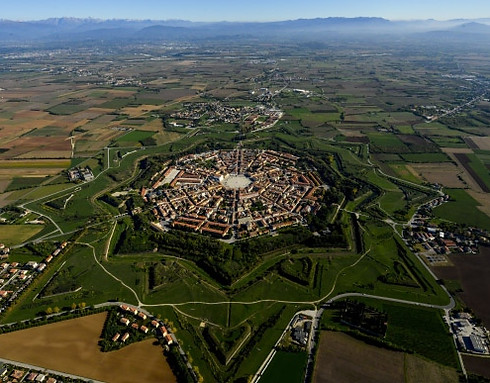
Palmanova
Palmanova (Palme in Friuli) is a fortress city planned by the Venetians in 1593, it is called the "starred city" for its polygonal star-shaped plan with 9 points.
Since 1960 the historic city is a national monument. Since 9 July 2017, the fortress of Palmanova has become part of the Unesco World Heritage Site, on the transnational serial site "Venetian defense works between the 16th and 17th centuries: the State from the Land-State from the Western Sea".
To be seen:
-
The three monumental gates that allow access to the city
-
Piazza Grande,
-
The cathedral of Palmanova (1615-1636)
-
The historic civic museum of Palmanova,
-
The Military Historical Museum
.
Aquileia
Aquileia (original Friulian Olee, modern Friulian Aquilee, original Friuli, modern Friulian Gorizia) is an Italian municipality of 3 302 habitants of the province of Udine in Friuli-Venezia Giulia. Roman colony founded in 181 B.C., was capital of the X Augustan region and metropolis of the Christian church. Together with Ravennae Brescia is the most important archaeological site of northern Italy, and with Cividale del Friuli and Udine it was one of the historical capitals of Friuli, whose banner derives from the emblem of Aquileia.
The village develops around the patriarchal basilica for a radius of about a kilometer, incorporating also the remains of the ancient Roman city,

Grado
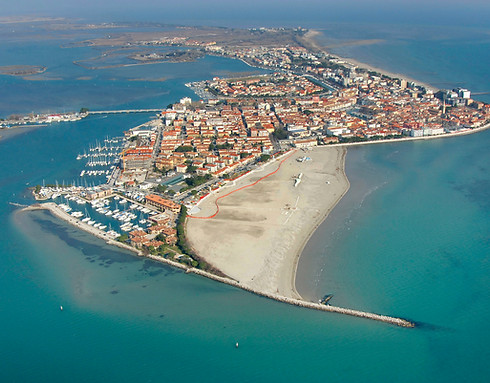
It is an important tourist and thermal center, also known as the Isola del Sole and, due to its particular history, the Prima Venezia.
The territory of the municipality of Grado extends between the homonymous lagoon, the Isonzo river mouth and the Adriatic Sea. The capital is located on the main island and is divided into several areas and districts: Gravo vecia (the ancient city enclosed by the perimeter of the Roman castrum), Borgo de Fora, Isola della Schiusa, Colmata, Centro, Squero, Città Giardino, Valle Goppion - former Valle Cavarera, Grado Pineta, Primero.
The lagoon includes about 30 islands and covers an area of about 90 square kilometers. In addition to the main island, the island of Schiusa, connected to Grado with two bridges, and the island of Barbana are also permanently inhabited.

San Daniele del Friuli
San Daniele is in the center of Friuli and dominates the surrounding plains. A collecting and welcoming city with several artistic treasures. The territory enjoys a particular air that gives to the hams (locally produced), a unique and unmistakable taste known all over the world.
To visit:
-
The Guarneriana Library, one of the oldest public library in Italy, founded in 1466 by Guarnerio d'Artegna, who donated 173 manuscripts to the church of S. Michele;
-
Cathedral of San Michele Arcangelo
-
Museum of the territory, housed in the cloister of the old hospital
-
House of the '300
-
Church of Sant'Antonio Abate, famous for its wonderful frescoes, made between 1497 and 1522 by Martino da Udine.
-
Church of Santa Maria della Fratta, dating back to the fourteenth century
-
St. Andrew's Church, from the 13th century